The Carmel Basement: Why Mitigation Comes First
A homeowner near 116th Street called us at 6:14am on a Saturday after his sump pump had failed sometime overnight. Roughly 1,400 square feet of finished basement, three to four inches of standing water, soaked carpet, swollen baseboards, and an unfinished panic about a daughter's wedding scheduled there in nine days. He asked one question on the phone: "Can you rebuild it by next Friday?"
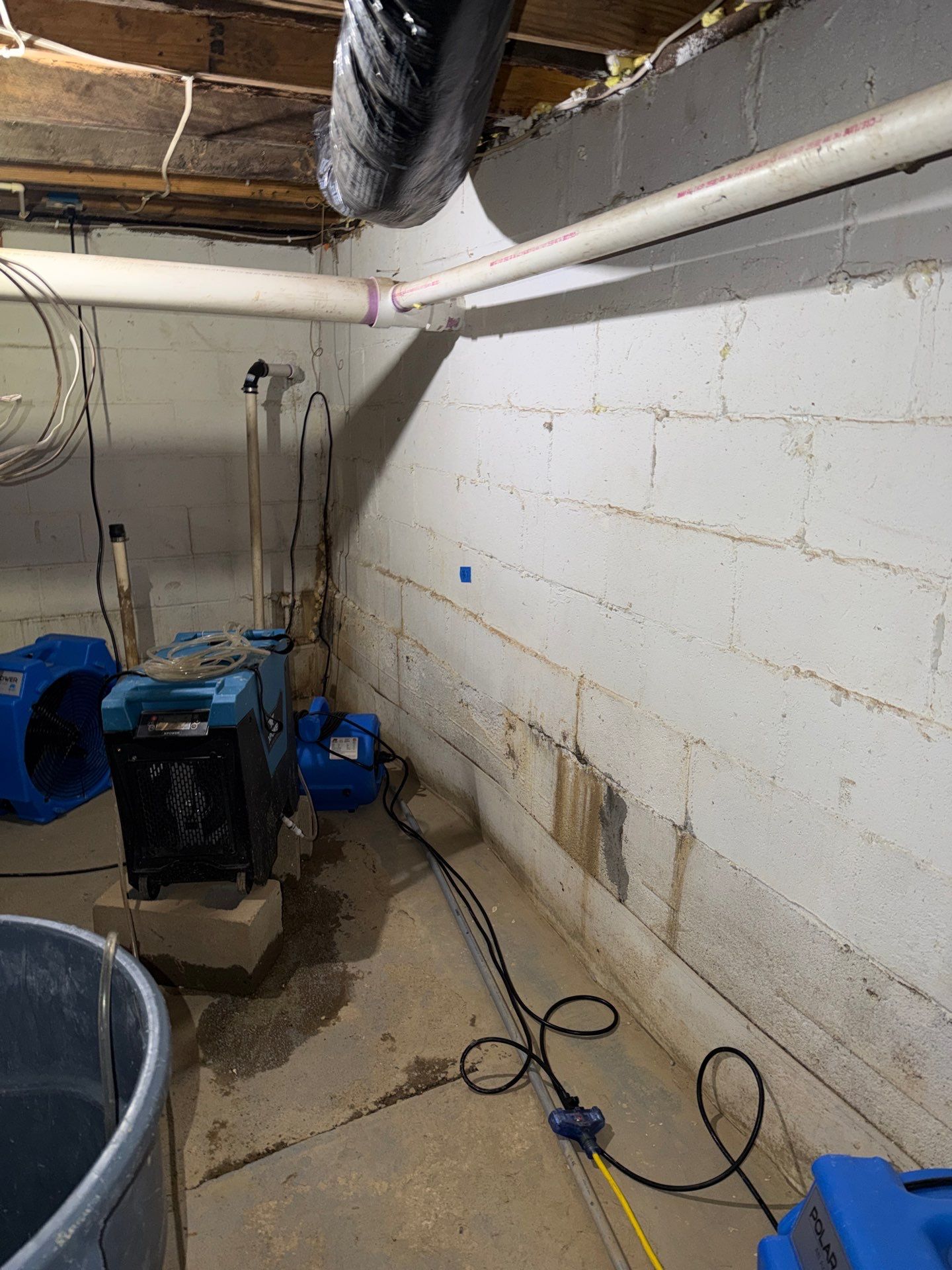
The honest answer was no, and we said so. Rebuilding before mitigation is finished is how mold ends up sealed inside a wall cavity six months later. Our crew arrived in 47 minutes with truck-mounted extractors and pulled standing water for the first three hours. Then came moisture mapping with thermal imaging, which showed wet drywall climbing 18 inches up the studs in three separate rooms. We performed controlled flood cuts, set 14 air movers and four commercial dehumidifiers, and monitored the structure twice daily for the next four days. Total mitigation cost: just under $4,800, fully covered by his policy after the $1,000 deductible. He learned what most people do not, which is that water mitigation services and emergency drying are the foundation everything else sits on.
The wedding happened, by the way. Not in the basement, but in a tent his brother-in-law rented Thursday afternoon. The basement was bone dry by then, framed back out, and ready for drywall the following Monday. He told us later that the hardest part was accepting that the pretty work could not start until the invisible work was finished. That is the whole lesson in one sentence.
The Fishers Kitchen: When Restoration Starts
A different scenario, same week. A family in Fishers came home from a long weekend to find a dishwasher supply line had failed sometime Friday. The water had run for an estimated 60 hours. Engineered hardwood was cupped, cabinet kickplates were black, and the ceiling below was sagging.
Here is where the line between mitigation and restoration gets sharp. Mitigation handled the extraction, the demolition of unsalvageable flooring, the removal of soaked cabinet bases, and three days of structural drying. Restoration began on day five: new subfloor sections, replacement cabinets matched to the existing run, new hardwood feathered into the dining room, ceiling drywall, primer, paint, trim. Mitigation ran about $6,200. Restoration ran $19,400. Both phases were submitted as one claim with documentation we provided to the adjuster, including moisture logs, equipment run times, and photo records. The homeowner paid one deductible.
One detail worth pulling out of that job: matching the hardwood. The original floor was a discontinued species and finish, so our trim carpenter pulled boards from a pantry closet to feather into the main run, then refinished the entire visible field so the repair disappeared. That kind of craft only matters if mitigation was done correctly first. If we had skipped a day of drying to start the rebuild earlier, the new hardwood would have cupped within a month from residual moisture in the subfloor, and we would have been tearing it back out on our own dime.
The Zionsville Slow Leak Nobody Saw
One more story, because it is the kind of job that catches people sideways. A Zionsville homeowner noticed a faint musty smell in her guest room and a small ripple in the baseboard paint. No visible water, no dripping, no obvious source. Our moisture meter found a saturated wall cavity behind the closet, fed by a pinhole leak in a copper supply line that had been weeping for an estimated six to eight weeks.
Mitigation here was small in square footage but layered. We opened the wall, dried the cavity over four days, and tested air samples because mold colonies had established inside the bay. Restoration was minor drywall and paint, under $2,200. The hidden cost was the plumber's pipe repair and the air quality clearance test we required before closing the wall. Slow leaks are sneakier and often more expensive per square foot than dramatic floods, because the damage compounds in silence.
The Village of West Clay Question Most People Ask Wrong
The most common call we get is, "How much does water damage restoration cost?" That question is doing too much work. What people usually mean is, "What will the whole thing cost me, start to finish?" Mitigation in central Indiana typically runs $2,500 to $7,500 for residential jobs depending on square footage affected, water category, and how long the water sat. Restoration varies wildly based on finishes, anywhere from $3,000 for a simple drywall and paint job to $40,000 or more for full basement rebuilds with custom built-ins.
The IICRC categorizes water into three classes that drive this pricing more than any other single factor:
- Category 1 is clean water from a supply line or fresh source, the cheapest to address.
- Category 2 is grey water with contaminants, including dishwasher and washing machine discharge.
- Category 3 is black water from sewage, flooding, or any water that has sat long enough to grow bacteria.
Knowing your category before the adjuster shows up changes how the claim is written. If you are unsure, the breakdown in category 1 vs category 2 vs category 3 water damage walks through real examples we see in Village of West Clay homes weekly.
What This Means for Your Village of West Clay Home Right Now
If you are reading this with water actively spreading somewhere in your house, the order is simple. Stop the source if you safely can. Document everything with photos and video before you move a single item. Call a certified mitigation company before you call your insurance, because adjusters want to see active mitigation underway, not standing water that has been ignored for a day. Village of West Clay Water Restoration has handled thousands of these calls across Village of West Clay and central Indiana, and we will tell you on the phone whether your situation needs full mitigation, partial drying, or just a careful inspection.
The Westfield Sewage Job: Why Speed Decides Everything
A Westfield client called on a Sunday with sewage backing up through a basement floor drain. By the time he reached us, contaminated water had been sitting roughly 14 hours. This was Category 3 from the start, which meant PPE, containment barriers, antimicrobial application, and disposal of any porous material it touched. Carpet, pad, the bottom 24 inches of drywall, and a finished bathroom vanity were all non-salvageable per IICRC S500 standards. Mitigation alone ran $11,200 because of the contamination protocols.
What hurt more was the timeline. Mold begins colonizing wet organic material within 24 to 48 hours, so any delay in mitigation directly increases restoration scope. He waited until Sunday morning to call because he thought it might "dry out on its own." It does not. It never does. The longer water sits, the more your mitigation phase expands into restoration territory, and the more your final number climbs.